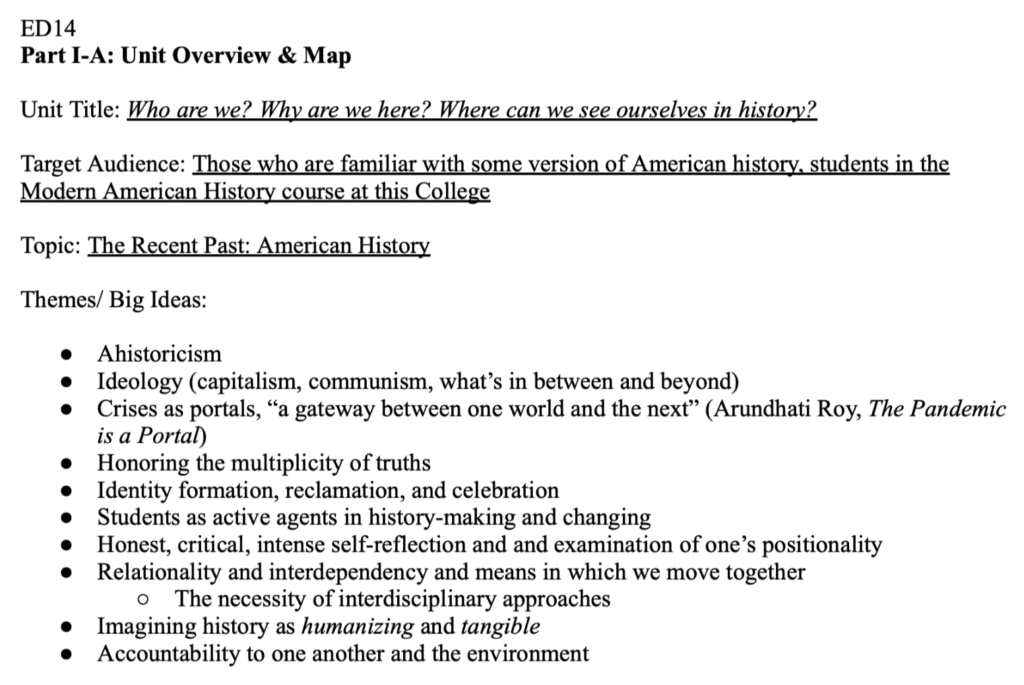
one of the things we tried to do for every class was to have someone share something in relation to the topic of the week. in my show & tell, i decided to share the syllabus i re-wrote for the modern american history course at the college. having just taken my first history course here, i felt compelled to re-write the syllabus for a final project in ed14 (intro to ed). this was the product that materialized through the release of many, many weeks of pent up frustration.
I look back at this syllabus and am reminded of how both confusing, joyous, and freeing reimagining learning pathways and destinations can be. it also grounds me; theory doesn’t always mirror praxis, as I’ve learned in our student-led course.
![Screenshot of google doc says, "Part I-B: EUs/EQs
Enduring Understandings
What do you want students to remember 10 years from now?
There is no such thing as an unbiased version of history. By virtue of how history is made, that is, it is an account of people’s experiences and what they were able to witness, history is constantly being made, discovered, and remade.
The history we often do know of is a product of power imbalances. Just as knowledge production and educational institutions were made, and continue, to provide resources for a small privileged population, it is important to be weary that the sources and viewpoints we examine in class will offer only a very small snippet of the vast range of truths that exist; especially in a classroom setting at a PWI, that is Swarthmore College. We will touch upon the idea of the production of salience in informing what we know and what we don’t know to ground and inform our practice as historians.
Contrary to its apparent intended purpose, the field of history has a tendency, as well as a long record, of serving a dehumanizing agenda. The process of making history ahistorical, that is, decontextualized from a deeper and more critical analysis of a certain event or structure, is something we have become accustomed to and oftentimes, comfortable with. Ahistorical learning perpetuates harmful understandings of the past, the present, and limits our ability to imagine and dream about a safe, life-affirming, community-based, [I challenge the reader to insert another tenet we should work towards in this class and beyond, here], and justice-driven future.
As people who have crossed multiple physical and metaphysical borders over an enormous expanse of time being that we are naturally migratory beings, we recognize that our histories are interconnected and it is the histories we choose to preserve and study, regardless of dominant destructive and covert programs that aim to erase our identities, that help us in our life-long journeys to understanding who we are and what we will do to share and embody our truths. We must do this with humility and willingness to actively self-reflect on our experiences, beliefs, affinities, and biases. We must be willing to listen and join in conversation when we are called upon. We must also recognize that participation looks different for every individual and must thereby provide and support sufficient alternative modes and spaces to contributing to the (un)learning we aim to do together.
You will never know everything there is to know about history which is why it’s important to develop habits in which historicizing ideas and events becomes second-nature. Asking why and how something has occurred is essential to nurturing the innate historian each of us are, by virtue of wanting to know more about ourselves and each other, and therefore be able to care for and support one another.
I’ve added this fifth point simply as a place-holder for possible understandings that might arise throughout the course, in recognition that curriculums are just a starting point and always subject to change."](http://apiafutures.domains.swarthmore.edu/wp-content/uploads/2022/04/Screen-Shot-2022-04-25-at-9.23.46-PM-933x1024.png)


